Status: pre-clinical. Engineering prototypes in active development.
“The hardest parts of this field are not only technical. They are about fit, comfort, cost, access, and trust.”
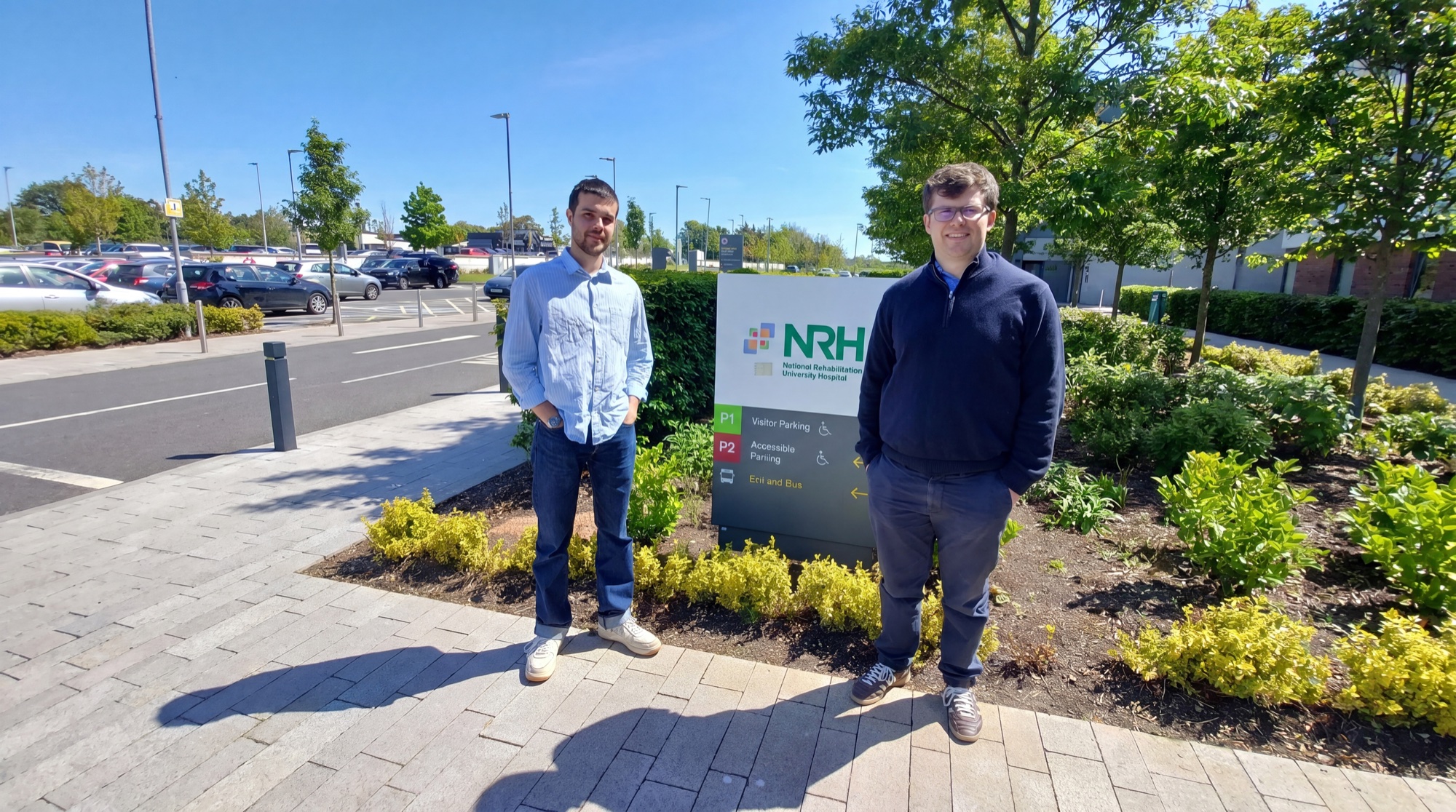
Earlier this month, my co-founder William and I spent a morning at the National Rehabilitation Hospital in Dun Laoghaire. We were there to watch something that sounds simple on paper: a prosthetist fitting a patient for a new socket. By the time we left, about forty minutes later, we had a far sharper picture of the problem ReAble exists to solve, and a good deal of respect for the craft involved in solving it the conventional way.
Here is what we saw, what we learned, and how it is already shaping the way we build.
The workflow, start to finish
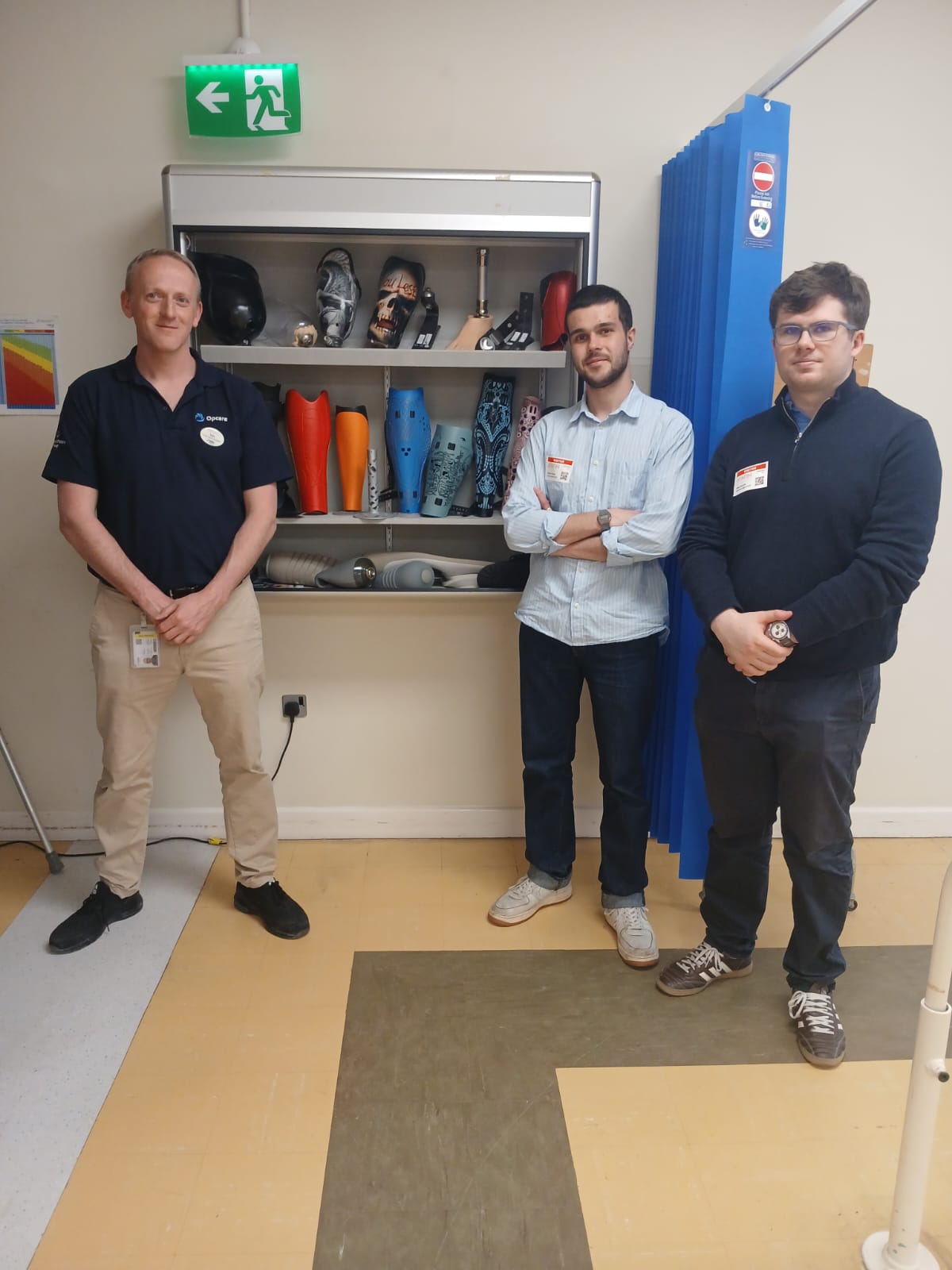
We were hosted by prosthetist Iain Briggs, who talked us through the refitting of a patient with a transradial (below-elbow) amputation. The patient’s existing prosthesis was body-powered, meaning the hand opens and closes through the patient’s own movements rather than motors. It pairs with a silicone stump sock that rolls up past the elbow, with a metal attachment at the end that engages and disengages the socket and hand.
That silicone sock turns out to be doing a lot of quiet work. Iain explained that it is the standard interface because it disperses pressure from the socket across as large a surface area as possible, and copes with the shear forces created as the device moves against the limb. The socks come in standard sizes that step up in roughly 2 cm increments, and the prosthetist deliberately selects one slightly smaller than the limb’s circumference so it grips firmly enough to hold a surprisingly heavy device in place.
The reason for this particular refitting was instructive. The patient’s residual limb had become more swollen over time, so a socket built around earlier anatomy no longer fit comfortably. Iain told us this is common: residual limbs change shape, and patients routinely need their socket remade. That reframed something for us. We had been focused on day-to-day volume changes in the limb, and had under-weighted the bigger, recurring need for a new socket every time the limb changes enough to make the old one painful. A workflow that cannot deliver a replacement quickly and affordably leaves patients uncomfortable for longer than they should be.
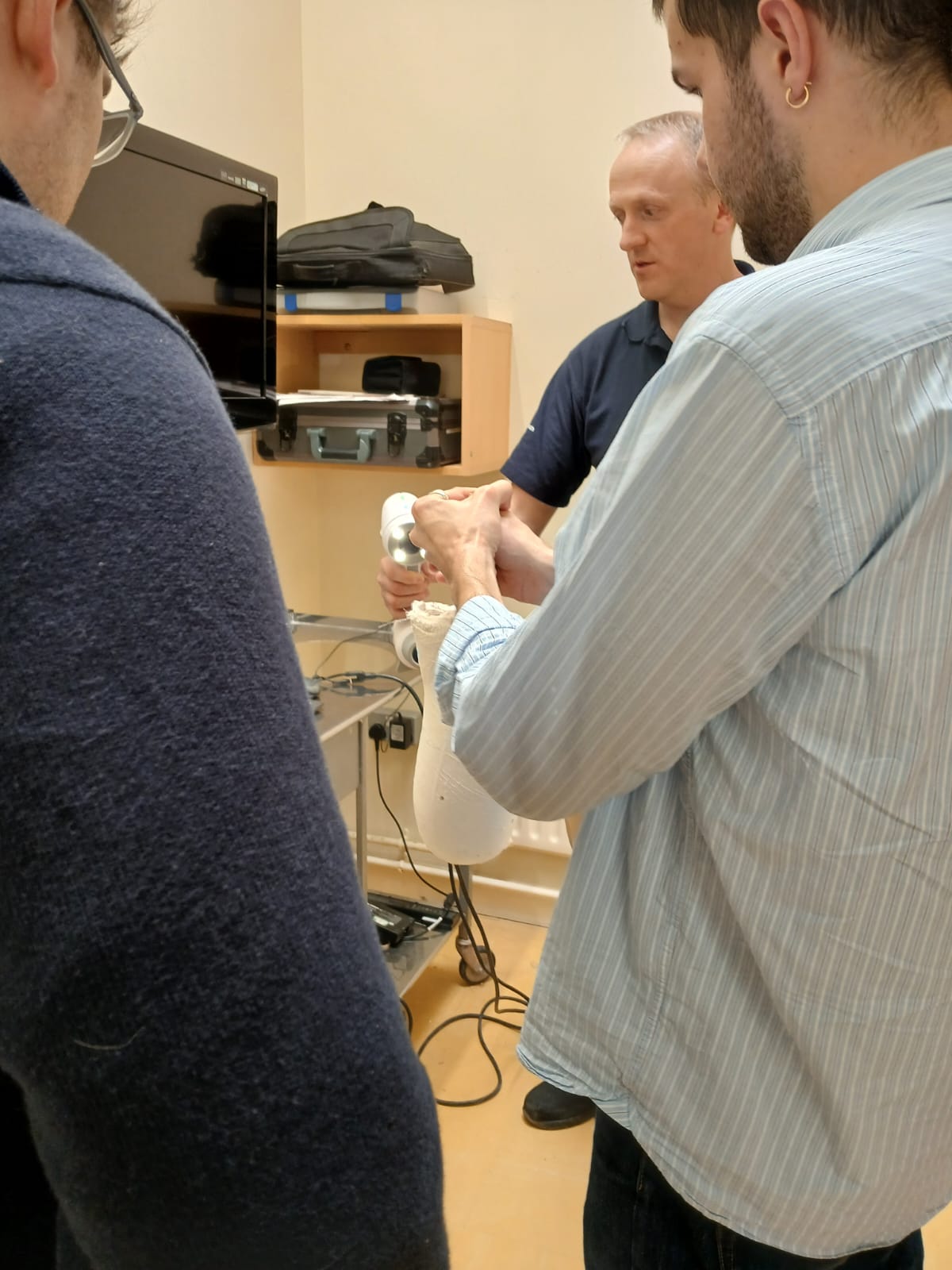
The refitting itself still relies on plaster of paris. The sock is wrapped in cellophane, then plaster is applied with the elbow near full extension. Key landmarks are identified by hand, the olecranon and the points just above the medial and lateral epicondyles, so the finished device preserves pronation, supination, and full elbow flexion. We watched Iain cut a wedge from the cast to free up elbow flexion, manipulate it where it caught on the olecranon, then take it on and off to confirm a clean fit, and finally mark the alignment for the attachment point.
What happens after that is where the digital pipeline begins. A full mould is produced and scanned with an Omega scanner to generate a 3D render, which becomes a CAD model of the socket. The patient trials that at a later appointment, and if it is right, a final device is produced with a custom 3D-printed socket shell, followed by ongoing follow-up.
The realities that don’t appear on a spec sheet
A few numbers from the visit have stayed with us:
- ·For this patient, it was roughly 18 months from amputation to receiving a first prosthetic.
- ·Once funding, wound healing, and device assessment are sorted, fitting to delivery is around 3 weeks.
- ·Device selection is typically made by an occupational therapist using the Canadian Occupational Performance Measure, which weighs what matters most to the patient across self-care, leisure, and productivity, and is then used to justify the choice to whoever is funding it.
- ·Funding has no single national approach. The hospital where the amputation takes place usually pays, except in Cork University Hospital and University Hospital Kerry, which apply to community budgets instead.
- ·The abandonment rate Iain recalled was around 50%, with international figures available through the ISPO.
That last figure is the one worth sitting with. When roughly half of devices end up unused, the gap between what is technically possible and what actually helps people is the whole problem.
Myoelectric devices and the silicone sock
This part was directly relevant to us, since the hand we are building is myoelectric. Iain explained that many myoelectric devices place electrodes in holes cut into the silicone sock. The catch is that the sock has to be put on in exactly the same position every time, or the signals driving the hand are inconsistent. The practical fix is simple: alignment markings on the sock, the same idea as the positioning marks on a blood-pressure cuff. He also noted that training on myoelectric devices is usually handled by the device provider rather than the hospital.
How we want to change this
The protocol we are working towards at ReAble flips the front end of this process. A patient captures a scan of their residual limb, with the silicone sock on so it reflects the surface the device will actually sit against, using any phone with LiDAR. A parametric algorithm translates that scan into a CAD model of the socket, which the prosthetist reviews and approves before anything is produced.
The goal is a lower-cost, faster route to a well-fitting socket, so a replacement is available close to when the patient needs it rather than weeks later. The clinician stays in control of the outcome; the technology just removes the slow, manual steps in between.
What Iain told us to get right
We asked Iain directly how feasible he thought this would be to slot into the current clinical workflow. His answer was encouraging, and he believes it can be done. He gave us two cautions that have since become design principles for us:
- 1.Validate the scan-to-model pipeline rigorously. That means gathering many real scans from transradial patients and proving the algorithm translates them into suitable socket models accurately and consistently, not just in principle.
- 2.Keep prosthetists at the centre. A similar project had been attempted before and ran into trouble because the software side produced models that looked better to engineers but missed what is anatomically required for function. The people building the CAD did not fully understand the clinical requirements. Whatever we build has to retain exactly what a prosthetist needs for their patient.
Both points are now baked into how we are developing the system.
Closing the loop
We came away grateful to Iain and the NRH for the time and the candour. Watching a fitting in person did more for our understanding than any amount of reading could have, and it confirmed something we keep coming back to: the hardest parts of this field are not only technical. They are about fit, comfort, cost, access, and trust, and getting those right is the difference between a device that helps and one that ends up in a drawer.
That is the part of the problem we are most determined to solve.
Stay tuned. Our full clinical evaluation is coming soon, and we will be sharing what we found.
Next step
Want to take the next step?
No commitment, no pressure. A chat about what might be possible.
Work with us